



































The Architect of Classical Melody: Remembering the Soulful Legacy of Maestro Roshan
On his birth anniversary, we look back at the monumental journey of legendary music composer Roshan Lal Nagrath, whose classical mastery birthed some of the most enduring melodies in Bollywood history.
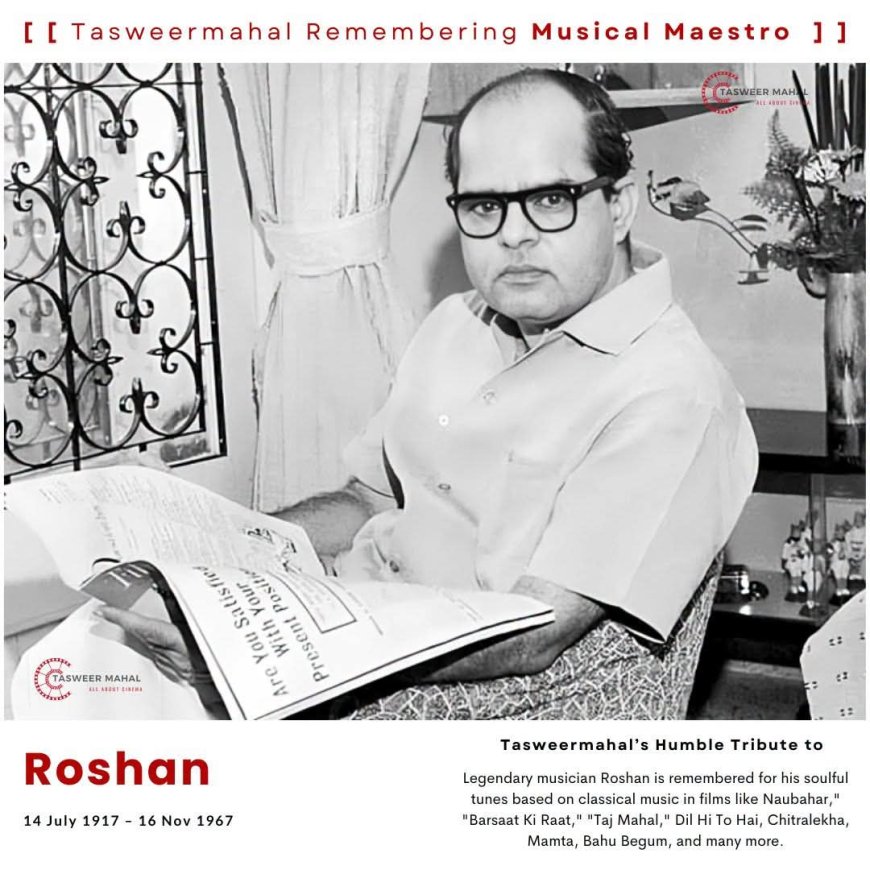
The architectural beauty of the golden era of Hindi film music was built on the unyielding foundations of classical ragas and soulful instrumentation. Among the premier titans who shaped this melodic landscape, composer Roshan Lal Nagrath stands as a brilliant pioneer whose creations continue to echo across generations. Born on July 14, 1917, in the small village of Bharia within the Punjab province, his artistic journey was defined by a deep, unwavering devotion to musical purity. Long before his melodies captured the collective imagination of a newly independent nation, Roshan systematically immersed himself in the structural complexities of traditional instruments and vocal disciplines, preparing himself to revolutionize the sonic identity of Indian cinema.
His early formative years marked a steady migration toward the cultural heartlands of Northern India, initiating a rigorous academic exploration of sound. Moving to Shahjahanpur during his primary schooling, he began his initial mechanical training under Master Barve, developing a sharp command over the harmonium. This foundational curiosity eventually led him to the prestigious Marris College of Music in Lucknow, where his raw sensibilities were refined under the strict, scholarly guidance of Pandit S. N. Ratanjankar. Not content with mastering a single framework, Roshan subsequently traveled to Maihar to master the intricate nuances of the sarangi under the legendary Ustad Alauddin Khan. This vast academic background also transformed him into a highly prominent player of the esraj, a rare stringed instrument that secured him his initial professional employment at All India Radio, Delhi, in 1940, alongside cultural visionary Khawaja Khurshid Anwar.
This extensive instrumental background served as his definitive launchpad when he finally migrated to the high-stakes environment of the Mumbai film industry. Making his official debut as an independent music director with auteur Kidar Sharma's Neki Aur Badi in 1949, it was the subsequent 1950 musical triumph Baawre Nain that officially established his commercial and critical credentials. The track Khayalon Mein Kisi Ke Is Tarah Aaya Nahin Karte, brought to life by the distinct vocal styles of Mukesh and Geeta Dutt, rapidly evolved into a national sensation. This initial breakthrough set the tone for an exceptionally productive two-decade journey, during which Roshan systematically calibrated his intricate, raga-based arrangements to harmonize with the unique vocal timbres of iconic playback legends like Mohammad Rafi, Talat Mehmood, and Lata Mangeshkar.
The decade of the 1960s witnessed the absolute zenith of Roshan's compositional genius, characterized by a series of monumental blockbusters that redefined the commercial viability of classical cinematic music. In 1960, his soundtrack for the Bharat Bhushan and Madhubala starrer Barsaat Ki Raat achieved legendary status, with timeless tracks like Zindagi Bhar Nahin Bhoolegi Woh Barsaat Ki Raat and the explosive qawwali dualities of Na To Karvan Ki Talash Hai and Yeh Hai Ishq Ishq generating unprecedented public frenzy. This golden run reached its ultimate industry validation in 1963 through the parallel releases of Dil Hi To Hai and Taj Mahal. While the former showcased his unmatched capacity to translate heavy semi-classical bandishes into commercial hits through Laaga Chunri Mein Daag, the poetic grandeur of the latter earned him his career's singular, historic Filmfare Award for Best Music Director.
As the industry transitioned deeper into the mid-1960s, Roshan’s creative output refused to compromise its core academic integrity for passing commercial trends. His score for the 1964 cinematic masterpiece Chitralekha remains a monumental textbook for aspiring music students, particularly celebrated for the deep philosophical introspective piece Man Re, Tu Kaahe Na Dheer Dhare. This flawless trajectory continued with the high-stakes emotional landscapes of Mamta in 1966, an album that gifted the world immortal melodies like Rahen Na Rahen Hum. Even as he crafted the complex, highly stylized Urdu-infused arrangements for Bahu Begum in 1967, his work retained an organic, deeply human texture that separated his portfolio from his contemporary peers.
Though his brilliant life was tragically cut short on November 16, 1967, the profound spiritual echoes of his compositions ensured that his creative presence never truly departed from the cultural fabric of India. Posthumous releases like Anokhi Raat in 1973 continued to deliver chart-topping standard classics such as Oh Re Taal Mile Nadi Ke Jal Mein, cementing his permanent status as a timeless master of melody. Beyond the archival brilliance of his discography, his immense artistic lineage continues to dictate the creative destiny of mainstream Indian cinema. Through the visionary directorial eye of his son Rakesh Roshan, the compositional genius of his younger son Rajesh Roshan, and the unparalleled cinematic charisma of his grandson Hrithik Roshan, the foundational artistic integrity of the patriarch continues to thrive, proving that true melody knows no expiration date.