














































The Stillness of Stone: How a Spiritual Pilgrimage to Gujarat Anchored Entrepreneur Gauravv Saxena’s Business Mind
Entrepreneur and travel creator Gauravv Saxena shares how his spiritual journey to Somnath, Nageshwar, and Dwarka became a vital anchor, helping him find clarity and balance after relocating from Uganda back to Mumbai.
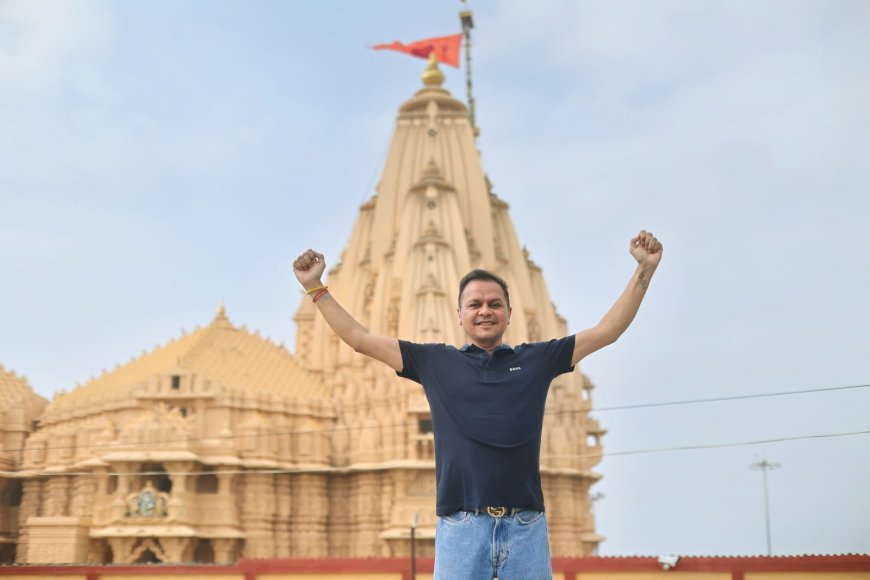
In the high-velocity landscape of modern entrepreneurship, the pursuit of growth often eclipses the pursuit of self. For business leaders, the mind is a perpetual engine of calculation, strategy, and risk assessment. Recognizing the silent toll of this constant alertness, entrepreneur and digital travel creator Gauravv Saxena recently embarked on a sacred pilgrimage to the coastal spiritual centers of Gujarat, seeking a deliberate pause. His journey through the majestic Somnath Temple, the ancient Nageshwar Jyotirlinga, and the divine Dwarkadhish Temple in Dwarka quickly transcended the boundaries of traditional tourism. For Saxena, this sacred trail was not merely a checklist of historical landmarks but a profound, inward exploration that allowed him to realign his entrepreneurial spirit with a deeper, universal rhythm.
This spiritual retreat arrived at a crucial juncture in Saxena's life, serving as an emotional ballast following a period of monumental transitions. Having spent years cultivating business ventures abroad, he recently underwent the complex process of relocating his entire life and career from Uganda back to the bustling metropolis of Mumbai. Navigating the sheer velocity of this transition, alongside the demanding responsibilities of expanding his digital footprint, left him yearning for a rare form of clarity. He realized that the answers to his deepest questions could not be excavated within a corporate boardroom or captured through a camera lens. Instead, he sought the heavy, deliberate stillness preserved inside the ancient, stone-hewn corridors of India's most venerated sanctuaries.
At the core of Saxena’s spiritual worldview is a deep, highly philosophical connection with Lord Shiva, whom he perceives as the ultimate emblem of equilibrium. In Hindu theology, Shiva beautifully balances the paradox of being both the silent, deeply meditative ascetic and the dynamic, cosmic creator. For an entrepreneur, this duality offers a reassuring mirror to the cyclical realities of the marketplace. Saxena views Shiva's destructive aspect not as an end, but as a mandatory precursor to innovation—a cosmic reminder that business processes, structures, and legacy systems must often be completely dismantled to clear a path for fresh creation. This profound perspective allows him to maintain a steady, quiet center even when surrounded by the inevitable turbulence of the startup ecosystem.
In his daily operations, Saxena treats spirituality not as an esoteric escape, but as a practical, foundational asset that actively protects his professional longevity. The life of a founder is characterized by a state of constant, low-level anxiety and high-stakes decision-making, which can easily lead to severe psychological burnout. By consciously tethering himself to a spiritual anchor, Saxena is able to occasionally "power down" his analytical faculties, stepping back to evaluate the grand design of his endeavors. This intentional grounding transforms his executive decisions, rendering them more intuitive, focused, and deeply purposeful. It ensures that his relentless ambition is constantly tempered with a profound sense of humility, keeping him close to his core human values despite the corrupting allure of material success.
To maintain this mental equilibrium amidst his demanding travel schedules and endless corporate meetings, Saxena relies on a set of simple, highly accessible daily rituals. He initiates his mornings not by scanning emails, but with quiet, mindful reflection to establish his intentions for the day ahead. When the pressure peaks during intense negotiations or long production shoots, he utilizes conscious, rhythmic breathing as an instantaneous psychological reset button to dissolve rising anxiety. Additionally, he has maintained a dedicated gratitude journaling practice throughout his personal and professional transitions. This simple act of putting pen to paper acts as a constant, humbling reminder to recognize and appreciate the blessings that decorate his journey, shifting his focus from what is lacking to what is abundantly present.
The immense spiritual resonance of his visits to Somnath and Nageshwar has planted a powerful seed for Saxena's future travels. While he consciously avoids setting rigid timelines or commercial deadlines for his personal devotion, the transformative energy of these ancient spaces has inspired him to eventually complete a pilgrimage to all twelve sacred Jyotirlingas across India. He envisions these upcoming sacred journeys as vital, soul-nourishing counterparts to the high-adrenaline, adventurous expeditions he regularly documents for his thriving audience on his lifestyle brand, "Beyond 9to5." Exploring these sacred geographic coordinates offers him a rare opportunity to showcase the profound heritage of India, proving that travel can be a vehicle for spiritual evolution just as much as physical discovery.
Ultimately, Saxena draws a brilliant, razor-sharp distinction between the nature of leisure travel and the deeper calling of spiritual tourism. While leisure journeys are fundamentally outward-facing—celebrated for culinary exploration, architectural wonders, and capturing the perfect aesthetic photograph—they primarily feed the intellectual curiosity of the mind, leaving the traveler temporarily refreshed. In stark contrast, spiritual travel is a demanding inward expedition. It is not defined by what a traveler consumes or takes away from a destination, but rather by what they choose to voluntarily leave behind—their deeply held anxieties, their professional ego, and their limiting attachments. For Saxena, these sacred pilgrimages do not merely offer a temporary escape from the grind; they deliver a permanent, lasting transformation, quietly guiding him back to the most critical destination of all: his own true self.