




























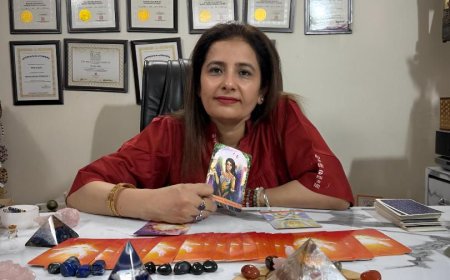


From Economics to Cinema: Anupriya Nagar talks about The Journey of Hanuman Ansh
In this candid interview, the producer of Hanuman Ansh reflects on her journey from studying Economics in the UK to entering cinema through a deeply personal connection with Maharaj Ji. She discusses the film's post-production challenges, financial risks, audience response, and the unexpected growth of its theatrical journey. She also shares her vision for the Hanuman Ansh trilogy, the lessons she learned as a producer, and what audiences can expect from the upcoming films.
1. What was the first moment when you felt that you had truly begun to understand the role of a producer?
It was when the entire list of pending post-production work was laid out in front of me, and we had to decide what needed to be completed first, where the budget had to be allocated, and how the release timeline had to be managed. That was when I realised that being a producer is not simply about investing money.
A producer does not necessarily need to know the answer to every question. But, ultimately, the responsibility for every problem rests with the producer. Perhaps that was the moment when I truly started seeing myself in this role.
2. How did you decide to enter cinema despite having a secure career path in Economics?
Coming into cinema was not a planned career shift for me. After studying Economics in the UK, I had a conventional and secure career path ahead of me. I also had the possibility of working in Switzerland.
But Hanuman Ansh did not come to me as a career opportunity. From the beginning, it was a personal and spiritual journey. I felt that the film needed me at that particular point in time. Even today, I believe that I did not choose this project. Maharaj Ji chose me for it, and gradually, cinema itself became my direction.
3. Your first connection with Neem Karoli Baba came while researching Steve Jobs and technology companies. What was it about that curiosity that eventually made it a part of your life?
Because of my interest in Economics and technology, I was researching Steve Jobs and some of the world's leading technology companies. During that research, I learned that Steve Jobs had travelled to India and wanted to visit Kainchi Dham.
My first question was: why was someone who had transformed the world of technology so deeply influenced by an Indian saint? That curiosity led me to read more about Maharaj Ji.
But the more I learned about him, the more it went beyond research. His teachings about love, service, and simplicity affected me deeply. Gradually, it began to feel as though I was not searching for him. Perhaps he was the one calling me towards him.
4. You had initially considered creating a book or comic about Maharaj Ji. How did cinema eventually become the right medium?
Initially, I had the idea of creating a book or comic because I wanted the younger generation to learn about Maharaj Ji. I did not decide to make a film because, by the time I became associated with Hanuman Ansh, the shooting had already been completed.
When the project came before me and I understood its vision, I felt that perhaps the answer to my question had already been prepared. Cinema can reach a much larger audience through emotions, music, visuals, and storytelling. Especially young people who may not necessarily read an entire book might still watch a film and become interested in learning about Maharaj Ji.
5. Apart from your financial contribution, what were your actual responsibilities during post-production?
When I came on board, the shooting had already been completed. So my responsibilities were not related to the set. My work began with taking the post-production process forward and ensuring that the pending work was completed.
This included planning the pending work, budget allocation, timelines, team coordination, distribution, marketing, release strategy, and the responsibility of taking the film to its audience. After that, screenings, promotions, and reaching out to different people to create awareness about the film also became part of my role.
After the release, when the number of screens began to decline, my responsibilities increased further. At that point, it was not enough to make decisions as a producer. It was also important to knock on every possible door for the film.
6. How did having three women producers from three different generations influence your decisions? What did you learn from them?
The three of us came from different age groups and had different experiences, so we often looked at situations differently. I tended to look at things from the perspective of a younger audience and through a digital lens, while Ragini Ji and Namrata Ji brought greater practical experience and patience.
That difference did not become a weakness. In many situations, it actually helped us arrive at more balanced decisions. I learned from them that passion alone is not enough. Patience, relationships, and the ability to remain composed during difficult times are equally important.
I feel that the three of us complemented one another.
7. Was investing your savings from the UK in the film an act of faith or a calculated risk?
It was a combination of both, but faith played the larger role.
I tried to understand the film's situation, the pending work, and the requirements ahead. As an Economics student, I did not completely ignore the numbers or the risks. But no calculation in cinema can guarantee success.
If this had been purely a financial decision, I probably would not have taken such a large risk. I made the decision because I felt that the film needed to be completed and needed to reach its audience. The calculations helped me understand the risk, but faith gave me the courage to make the decision.
8. When you told your father that you wanted to enter the film industry, his first question was how you would make your way into it. How do you look back on that conversation today?
His question was completely valid because our family had no background in the film industry. I had no network, and I did not even know myself how I would begin.
When I look back at that conversation today, I realise that I did not really have a practical answer at the time. Perhaps that was because I had not planned this path. It simply began taking shape on its own.
My family's concerns were always about my security and future. They certainly asked questions, but when they saw that this was not merely excitement or a passing interest, but a deep commitment for me, they supported me.
9. Which reaction from younger audiences surprised you the most?
What made me happiest was when young viewers told me that after watching the film, they searched for Maharaj Ji, read about his teachings, or started learning about Kainchi Dham.
Many young people also watched the film with their parents and grandparents. That was particularly meaningful to me because the film created a conversation between different generations.
My objective was not simply to bring them into theatres. I wanted the film to create a sense of curiosity in their minds after they watched it. When that actually happened, I felt that our effort had succeeded.
10. When the film went from nearly 300 theatres to around 30, what conversations were taking place within the team?
That was an extremely difficult time, both emotionally and practically. Our conversations were largely about which cities could still retain shows, where we were seeing audience response, and what the next step could be to increase awareness.
People were saying that the film was over and that the money invested in it would not come back. To be honest, at one point, the possibility of the film's theatrical journey coming to an end felt very real.
But we decided that as long as even one show was running, we would not stop trying. At that point, more than a grand strategy, what mattered was taking the next right step every single day.
11. What was the exact moment when you realised that something extraordinary was happening with the film?
It was not a single dramatic moment. But after receiving blessings from Bageshwar Dham, we began to see a rapid change in the online response.
Audience videos and messages started increasing. Theatres from which we had previously been hearing about reduced shows began reporting renewed demand and an increase in shows. For the first time, it felt as though the conversation was changing.
When people themselves began telling others about the film, I realised that the film was no longer just ours. The audience had made it their own.
12. What did this experience teach you about the economics of cinema and audience behaviour?
The biggest lesson was that an opening does not determine a film's final destiny. In cinema, awareness, timing, distribution, and word-of-mouth can completely change audience behaviour.
I also learned that a headline box-office number and a producer's actual recovery are not the same thing. After accounting for the theatre share, distribution expenses, marketing, taxes, and other commitments, the economics can look very different.
Data is important, but it cannot be interpreted without context. The initial data suggested that the film would not perform, but audience sentiment was gradually building in a way that the early numbers could not fully capture.
Success is not defined only by having a large opening weekend. Sometimes it takes time for an audience to discover a film.
13. Is the next film in the Hanuman Ansh franchise coming soon? What will your involvement be, and what can the audience expect?
Hanuman Ansh has been envisioned as a larger journey and a trilogy. So there are certainly plans for the films ahead. However, I would not like to announce any dates or details until everything has been officially finalised.
I will continue to be involved in the upcoming films. My aim will be to use everything we have learned from the first instalment to make the next film stronger in terms of storytelling, distribution, and audience reach.
The audience can expect a bigger canvas, deeper storytelling, and a stronger technical experience. But its soul will remain the same: Indian culture, faith, and stories that deserve to reach the new generation. The creative direction and final presentation will always be shaped by the collective vision of the director and the entire team.
What's Your Reaction?