
















































Almora’s Ravi Tamta Takes Flight: Successful Test Run of Indigenous Flying Car 'HAPIDA SKYNeX' Sparks Innovation in Uttarakhand
Almora innovator Ravi Tamta successfully test-flies HAPIDA SKYNeX, an indigenous electric personal flying vehicle prototype designed to revolutionize mountain travel and overcome Himalayan connectivity challenges.
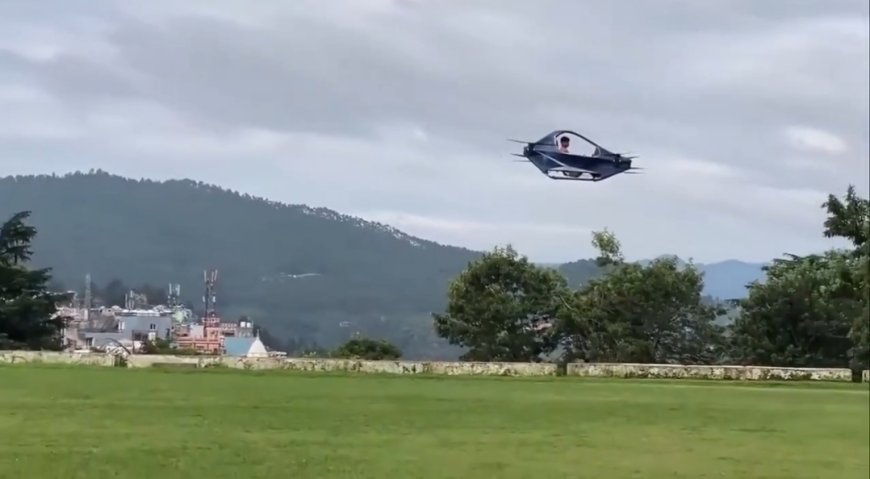
In a remarkable milestone for grassroots innovation and technological development in the hill state of Uttarakhand, young inventor Ravi Tamta from Kaflikhan village, located near the revered Jageshwar Dham shrine in Almora district, has successfully completed the initial flight demonstration of an indigenous flying vehicle prototype. Developed through his startup venture, Hapida Sky Private Limited, the single-seater electric flying machine named 'HAPIDA SKYNeX' represents a bold step forward in personal aerial mobility. Conducted on open ground in Almora, the successful airborne test run captured widespread public attention and social media interest, showcasing how mountain-based innovators are tackling complex geographical connectivity challenges through locally engineered technological solutions.
The HAPIDA SKYNeX prototype represents the culmination of years of dedicated research, technical experimentation, and incremental engineering trials led by Tamta and his small core team. Built upon advanced multi-rotor drone architecture and re-engineered with structural modifications to safely carry human payload, the vehicle relies entirely on electric propulsion. Unlike conventional aviation aircraft that require high-cost fossil fuels or complex runway infrastructure, this fully electric personal flying vehicle operates with zero tailpipe emissions, aligning directly with sustainable green energy goals while providing an alternative to ground transport in steep terrain.
For residents living across the rugged topography of the Kumaon region, daily commuting often involves navigating narrow, winding mountain roads where short straight-line distances translate into hours of driving. During initial route mapping and operational simulations, Tamta demonstrated that a typical 40-kilometer mountain journey between local settlements—which normally takes up to an hour and a half by road due to hairpin turns and traffic bottlenecks—could potentially be reduced to a swift 10 to 15-minute aerial flight. By converting ground-level travel obstacles into open sky corridors, the project highlights the immense practical utility that personal air mobility could bring to remote Himalayan communities.
This achievement is far from a standalone experiment for Ravi Tamta, who has established a long-standing reputation across Uttarakhand for his practical engineering creations and problem-solving mindset. Over the past two decades, Tamta has introduced multiple functional inventions designed specifically for rural and forest terrain, including a multi-utility walking stick used by state forest officials that integrates mobile charging capabilities and emergency lighting. His previous work also encompasses specialized electrolyte charging mechanisms, forest-fire mitigation equipment, and early-stage vertical mobility models. The maiden flight of HAPIDA SKYNeX marks his most ambitious project to date, turning a long-cherished dream of personal sky mobility into a tangible physical reality.
Beyond personal daily commuting, experts and regional observers point out that localized aerial vehicles hold transformative potential for public safety, emergency response, and disaster management across Uttarakhand. In a region frequently subjected to seasonal landslides, flash floods, and road blockages, compact electric flying vehicles could serve as vital lifelines for airlifting emergency medical supplies, deploying quick-response assessment teams, and establishing instant connectivity with isolated villages when land routes are severed. Furthermore, as clean aviation technology matures, zero-emission aerial transport could offer unique eco-tourism experiences across mountain landscapes without requiring heavy forest clearing for road expansion.
While the successful test flight of the HAPIDA SKYNeX prototype represents a monumental milestone for indigenous innovation, bringing personal flying vehicles to commercial or public markets involves navigating an essential multi-stage development roadmap. Any aerial mobility platform intended for human transport must undergo rigorous structural stress testing, redundant safety integration, battery safety certification, and formal airworthiness approvals from national civil aviation authorities like the DGCA. Tamta remains fully aware of these regulatory requirements and is actively preparing his startup for the next phase of formal testing, refinement, and institutional support, aiming to demonstrate that India's small towns can drive the future of next-generation transportation.